How Poor Sleep Affects Focus, Productivity, and Procrastination

Most people think their problem is focus.
Or procrastination.
Or lack of discipline.
They feel scattered.
They start tasks and drift.
They avoid things they know they should do.
So they assume something is wrong with their mindset.
But in many cases, the real issue is simpler:
They’re running on low capacity.
And one of the biggest drivers of that is sleep.
How Sleep Affects Focus and Productivity
When your sleep is off, a few predictable things start to happen.
Your brain avoids effort more aggressively
Tasks feel heavier than they should
You switch between things more often
Your decision-making becomes slower and less clear
You default to short-term relief (scrolling, avoidance, procrastination)
This is why people often say:
“I just can’t focus lately”
“I know what I need to do, I’m just not doing it”
It feels like a motivation problem.
But more often than not, it’s a recovery problem.
Your system doesn’t have the energy or clarity required to sustain attention and follow through.
What’s Actually Happening in Your Brain
Sleep doesn’t just affect how you feel.
It affects how your brain processes effort, decisions, and attention.
1. Your Cognitive Capacity Drops
Sleep plays a critical role in working memory and attention control.
When sleep is compromised:
your ability to concentrate weakens
you lose track of what you’re doing more easily
you become more distractible
This is why you might find yourself:
rereading the same thing multiple times
switching between tasks without finishing them
struggling to stay locked into a single line of work
It’s not a willpower issue.
Your brain simply doesn’t have the capacity it normally would.
2. Your Emotional Regulation Weakens
Sleep directly affects how your brain processes stress and emotion.
When you’re under-recovered:
small problems feel bigger
frustration rises more quickly
your tolerance for discomfort drops
This matters because procrastination is often driven by avoiding uncomfortable internal states, not the task itself.
When your emotional regulation is compromised, even mild discomfort becomes enough to trigger avoidance.
3. Your Decision-Making Becomes Less Reliable
Sleep deprivation affects the brain’s ability to evaluate decisions clearly.
You become more likely to:
delay decisions
second-guess yourself
choose short-term relief over long-term benefit
This is the core of procrastination.
You know what you should do.
But your brain prioritizes what feels easier in the moment.
4. Effort Feels Heavier Than It Should
One of the most overlooked effects of poor sleep is this:
Everything feels harder.
Tasks that would normally feel manageable now feel:
more effortful
more draining
easier to avoid
So you put them off.
Not because you’re lazy.
Because your system is trying to conserve energy.
Why This Happens
Sleep is not just about rest.
It’s about recovery.
And that recovery happens in cycles.
Sleep works in roughly 90-minute cycles, a concept popularized by sleep coach Nick Littlehales, where each cycle moves through different stages of physical and mental recovery.
One of the most important of these stages is deep sleep — the phase that largely determines your physical recovery and baseline energy the next day:
the body repairs itself
energy and baseline capacity are restored
the brain begins recovery processes that support next-day function
If you’re not getting enough quality cycles, or if your sleep is inconsistent, that recovery doesn’t fully happen.
The result is subtle, but powerful.
Your energy becomes unstable.
Your attention becomes harder to hold.
Your tolerance for effort drops.
And once that happens, procrastination becomes much more likely.
Not because you’re lazy.
Because your system is under-recovered.
How Sleep Actually Works (In Simple Terms)
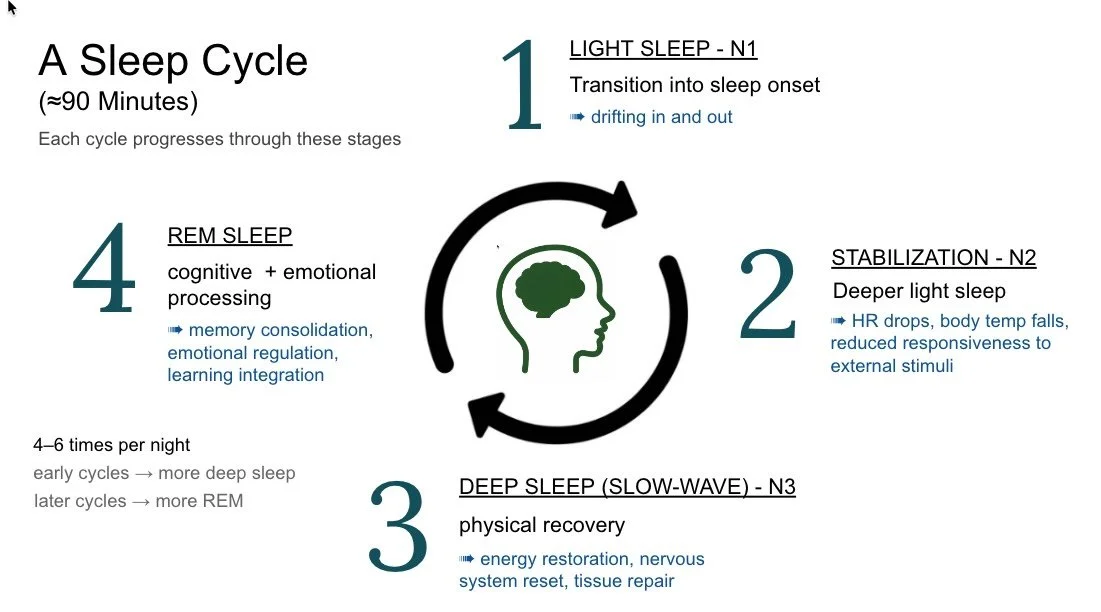
Sleep doesn’t happen all at once.
It moves in cycles — roughly 90 minutes each — and each cycle plays a different role in your recovery.
You move through:
Light sleep → drifting in and out
Stabilization → your system settles
Deep sleep → physical recovery and energy restoration
REM sleep → cognitive and emotional processing
This repeats 4–6 times per night.
Early cycles contain more deep sleep.
Later cycles contain more REM.
How to Maximize Deep Sleep (Without Overcomplicating It)
Deep sleep isn’t something separate you “get more of.”
It’s a critical phase within each 90-minute sleep cycle, especially in the earlier cycles of the night where most physical recovery takes place.
The goal is not to hack it.
It’s to protect your cycles so that deep sleep can happen properly within them.
A few factors drive most of the result:
Consistency of rhythm — Your body uses a circadian rhythm to time when it enters deeper stages of sleep. If your sleep and wake times shift, that rhythm becomes unstable, and your cycles become less efficient. A consistent wake time helps your body predict when to move into deep sleep.
Temperature drop — Deep sleep is triggered by a natural drop in core body temperature. If your environment is too warm, your body struggles to make that transition, which shortens or disrupts the deep sleep phase within each cycle.
Light exposure — Light controls your sleep timing. Morning light helps anchor your rhythm so your cycles run properly later that night. Late-night light delays the release of melatonin, pushing your cycles later and often reducing the amount of deep sleep you get in the early part of the night.
Mental load before bed — If your brain is still active and problem-solving, your nervous system stays in a more alert state. That delays the shift into deeper sleep stages, meaning your cycles start less cleanly and deep sleep is reduced.
Late stimulation — Alcohol, screens, and high stimulation don’t always stop you from falling asleep, but they fragment your cycles. When cycles are disrupted, deep sleep is often the first phase to suffer.
You don’t need to optimize everything.
You need to protect the structure of your sleep cycles.
When your rhythm, environment, and mental state are aligned, deep sleep happens naturally—and your recovery improves with it.
The Mistake Most People Make
Most people focus on when they go to sleep.
But the more important variable is:
When you wake up.
Your body runs on rhythm.
When your wake time is inconsistent:
your energy becomes unpredictable
your sleep quality drops
your focus becomes unreliable
Sleeping in on weekends, shifting your schedule, or waking at different times each day disrupts that rhythm.
Even if you’re technically getting enough hours in bed, the quality of your recovery suffers.
At the same time, many people unintentionally work against their sleep in other ways:
using screens late into the night
going straight from stimulation into bed
waking up and immediately checking their phone
missing early morning light
Individually, these seem small.
Together, they create a system that never fully resets.
A Better Way to Think About Sleep
Instead of thinking in terms of hours, it’s more useful to think in terms of cycles and rhythm.
Most people need somewhere between 4 and 6 sleep cycles per night (roughly 6 to 9 hours), but the exact number varies.
What matters more is:
consistency
quality of those cycles
how well your day supports them
A simple approach is to:
set a consistent wake time
work backwards to find a realistic sleep window
test different cycle counts (4, 5, or 6) across a week
notice how your energy and focus respond
You don’t need perfection.
You need a system that works consistently.
The First 60–90 Minutes of Your Day Matter More Than You Think

The period immediately after waking is one of the most important parts of your day.
This is when your body is primed to wake up fully.
Cortisol (your natural alertness hormone) is highest.
Your system is shifting from melatonin (sleep) toward serotonin (wakefulness).
What you do here sets the tone for your focus and energy.
A few simple adjustments go a long way:
get light into your eyes as soon as possible
avoid checking your phone immediately
hydrate
move your body, even lightly
If your first 30–60 minutes are filled with screens, notifications, and scattered attention, your day often follows the same pattern.
The Pre-Sleep Window Is Where Most People Lose the Game
Sleep doesn’t start when your head hits the pillow.
It starts in the 60–90 minutes before bed.
Most people try to fall asleep while their system is still in an “on” state.
They go straight from:
work
screens
stimulation
into bed…
And expect sleep to happen.
But sleep requires a shift in your nervous system.
During the day, your body operates in a more sympathetic state—alert, engaged, problem-solving.
To fall asleep, you need to move into a parasympathetic state—slower, calmer, and less stimulated.
That transition doesn’t happen instantly.
It needs to be created.
Think of This as a Transition, Not a Shutdown
If you don’t give your system time to downshift, it carries the day with it into bed.
That’s when you experience:
a racing mind
difficulty switching off
lying in bed while your thoughts keep moving
This is not random.
It’s a state problem.
A Simple Pre-Sleep Protocol
You don’t need a complex routine.
You need a consistent signal that tells your system it’s safe to slow down.
Start with:
dim the lights
reduce or eliminate screens
do something low-stimulation (reading, journaling, light stretching)
write down anything on your mind to “download the day”
If you want to go one level deeper, you can actively support the shift into a parasympathetic state:
slow breathing (longer exhales than inhales)
light stretching or yoga
quiet, repetitive tasks
The goal is not to force sleep.
It’s to create the conditions where sleep can happen naturally.
Why You Crash in the Afternoon
Many people experience a dip in energy in the early afternoon.
They assume something is wrong.
It’s not.
It’s part of your natural rhythm.
Instead of fighting it, you can work with it.
A short recovery period can make a significant difference:
20–30 minutes with your eyes closed
a short nap if it comes naturally
or simply stepping away and disconnecting
Even if you don’t fall asleep, allowing your system to downshift helps:
improve alertness
reset focus
stabilize energy for the rest of the day
Research has shown that even short naps can meaningfully improve performance and alertness.
Just as importantly, taking breaks throughout the day helps.
Your brain is not designed for continuous focus.
Working in roughly 90-minute blocks, followed by short breaks, aligns better with how your system actually functions.
Your Environment Shapes Your Sleep
Sleep is not just a behavior.
It’s also environmental.
If your sleep environment is working against you, your recovery will be too.
A few fundamentals make a big difference:
keep your room cool (around 16–18°C / 61–64°F)
make it as dark as possible
reduce clutter
treat your bedroom as a space for recovery, not stimulation
The goal is to make it easier for your system to switch off.
A Simple Reset
If your sleep, focus, and energy feel off, you don’t need to overhaul everything.
Start with a few key changes:
pick a consistent wake time and stick to it
get light exposure within the first hour of waking
create a 60-minute wind-down before bed
take one real break during the day
That alone will improve your baseline more than most people expect.
The Real Reframe
If you feel:
mentally scattered
stuck in procrastination
overwhelmed by simple tasks
It’s easy to assume you lack discipline.
But often, that’s not the case.
You’re trying to operate at a high level with a system that hasn’t fully recovered.
When sleep improves:
focus becomes easier
decisions become clearer
follow-through improves
Not because you forced it.
Because your system is working again.
If You Want to Go Deeper
If you’re dealing with ongoing issues around focus, procrastination, or follow-through, sleep is often one of the first places we look.
I work with people who want to:
rebuild focus
reduce avoidance
create consistent momentum
perform at a higher level without burning out
👉 Let’s talk— if what you’ve read resonates and you’re curious whether coaching could help, let’s explore it together.
