The Emotional Cycle of Change — A Core Tool for Managing Motivation
Over the past year, I’ve seen a similar emotional pattern show up in people navigating significant change.
It appears when someone has been laid off and is searching for work.
When someone starts a business or commits to a new goal.
When someone changes careers, goes through a divorce, enters retirement, or attempts a meaningful health shift.
Early on, there’s energy.
Then, somewhere along the way, motivation drops sharply.
Doubt increases.
Effort feels unrewarded.
Progress feels invisible.
Many people interpret this moment as proof that something is wrong — either with the plan, or with themselves.
More often, it’s something else.
It’s the emotional dip that tends to accompany real change.
Understanding that dip — and recognizing it as predictable — is one of the most powerful tools for stabilizing motivation during transition.
What the Emotional Cycle of Change Is
When people go through meaningful change, their emotional experience rarely moves in a straight line.
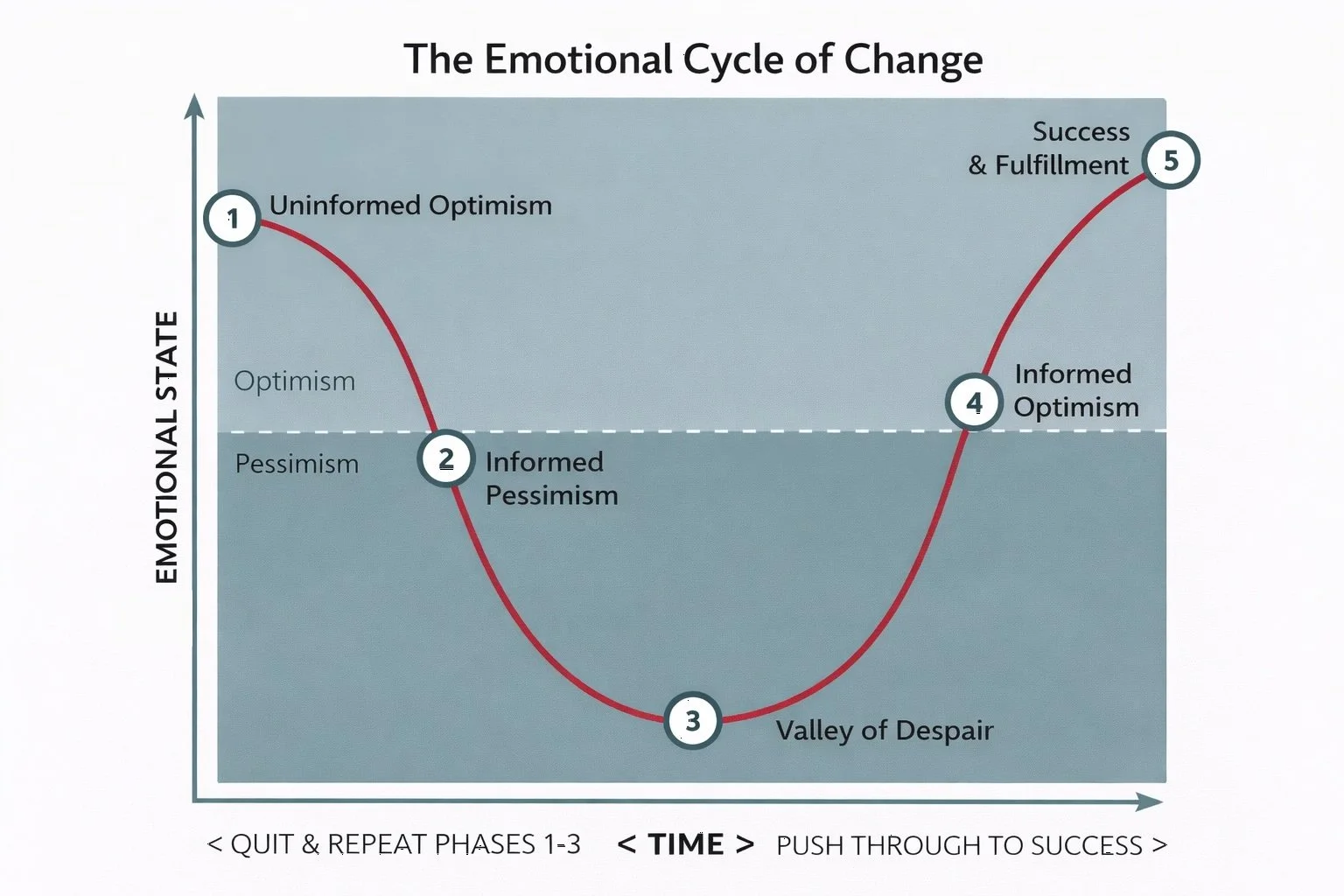
It tends to follow a recognizable arc:
Uninformed Optimism
Informed Pessimism
Valley of Despair
Informed Optimism
Success & Fulfillment
At the beginning, optimism is high. The possibilities feel real. The effort required feels manageable.
Then reality begins to surface. The task is harder than expected. Progress is slower. The emotional cost becomes clearer.
Eventually, many people hit what’s often called the Valley of Despair — a period where effort feels high and visible reward feels low.
This is where most people quit.
Not because they lack ability. Not because the goal is wrong. But because the emotional return no longer matches the effort being invested.
The Valley feels like failure. It feels like proof that something isn’t working. It feels like evidence that maybe this wasn’t meant for you.
But in many cases, the Valley appears after meaningful investment has already been made.
You’ve learned enough to lose naïve optimism.
You’ve invested enough to feel the cost.
You’ve done enough work to be uncomfortable — but not yet enough to see visible compounding.
In other words, you’ve already done half the work.
If someone stays with it long enough, skill improves. Friction decreases. Small wins accumulate. Optimism returns — but this time it’s informed, grounded in experience rather than fantasy.
This model isn’t a rigid law of psychology. But it captures a very common human pattern:
Progress is rarely emotionally linear.
The most dangerous point isn’t the beginning.
It’s the dip.
Two Types of Change
This emotional cycle shows up in both voluntary and forced transitions.
Voluntary Change
This is change you initiate.
Starting a business
Training for a marathon
Changing careers
Building discipline
Pursuing a creative goal
Voluntary change typically begins with optimism. Because you chose it, motivation is high. You haven’t yet seen the full cost.
Underestimation is common.
The emotional drop often feels confusing: “I wanted this — why does it feel so hard?”
Forced Change
This is change that chooses you.
Being laid off
Divorce
Health disruption
Industry shifts
Retirement
In forced change, optimism may be absent or brief. Identity feels shaken. The future feels uncertain.
The Valley can feel deeper here because it’s not just effort that’s being tested — it’s stability.
In both cases, the dip tends to appear.
The difference is how destabilizing it feels.
Why Motivation Drops
Low motivation during change is rarely random.
It usually reflects a collision between expectation and reality.
Misaligned Expectations
We underestimate:
How long it will take
How repetitive it will feel
How emotionally uncomfortable it will be
How invisible early progress will look
The cost in energy and patience
It often takes at least twice as long as we assume.
When expectations aren’t calibrated properly from the start, effort feels unrewarded.
You think:
“I’m putting in work and getting nothing back.”
The pain isn’t just difficulty.
It’s the gap between what you expected and what’s actually happening.
That gap creates demoralization.
Invisible Progress
In the early phases of change, growth often happens below the surface.
Skill builds before confidence does.
Reps accumulate before results show.
Competence strengthens before identity catches up.
When there’s no visible payoff yet, the brain interprets effort as inefficient.
But invisible doesn’t mean absent.
The return curve often lags behind the effort curve.
Identity Lag
During meaningful change, behavior shifts before identity does.
You may be doing the work.
But you don’t yet feel like the kind of person who succeeds at this.
The old identity is dissolving.
The new one hasn’t stabilized.
That in-between state feels unstable — and instability often shows up as low motivation.
Time Distortion
Emotional timelines are shorter than real-world timelines.
Three weeks can feel catastrophic.
Two months can feel like failure.
But most meaningful change operates on longer arcs than the nervous system anticipates.
When internal urgency collides with slow external progress, motivation drops.
Comparison Distortion
In the middle of your process, you’re most vulnerable to comparison.
You compare your messy middle to someone else’s visible outcome.
This resets your expectations again — upward — and deepens the Valley.
Reducing comparison during fragile phases isn’t weakness.
It’s protecting your motivational stability.
The Shame Spiral
When motivation drops, many people move from:
“This is harder than I thought.”
To:
“Maybe I’m not cut out for this.”
“It seems to be working for everyone else.”
“What’s wrong with me?”
This is the shame spiral.
Low motivation becomes evidence of inadequacy.
But the Valley of Despair is not a verdict on your ability.
It’s often a sign that your mental model is updating.
You’re moving beyond fantasy and into reality.
That transition is uncomfortable — but necessary.
How to Move Through the Valley

Understanding the cycle is helpful.
But what stabilizes motivation in practice?
1. Name the Phase
Instead of saying “I’m failing,” say:
“I’m in the Valley.”
Naming the phase reduces emotional intensity.
It shifts the narrative from identity to timing.
2. Lower the Daily Bar (Not the Vision)
When motivation dips, reduce the target.
Create a short “Today List.”
One small, process-based action.
Complete it.
Let it count.
Shift from outcome focus to process focus. Outcomes are volatile. Process is controllable.
3. Expect It to Be Hard
Most demoralization comes from expectation hangover.
If you assume:
It will take longer than you want
It will feel uncomfortable
There will be stretches with no visible reward
Then when those moments arrive, the emotional drop is smaller.
Lower expectations don’t reduce ambition.
They reduce volatility.
4. Vent Strategically
Journal honestly.
Talk to someone you trust.
Say out loud, “This is harder than I expected.”
Emotional discharge prevents frustration from turning inward into shame.
5. Protect Energy
Especially during forced change:
Prioritize sleep
Move your body
Limit constant metric checking
Motivation is fragile when energy is depleted.
6. Calibrate Scope
Sometimes the Valley isn’t telling you to quit.
It’s telling you to narrow.
Too many goals.
Too many simultaneous changes.
Too much cognitive load.
Simplifying is not surrender. It’s strategy.
The Turning Point

If you stay with it long enough, something shifts.
Skill increases.
Friction decreases.
Small wins become visible.
Confidence stabilizes.
Optimism returns.
But this time it’s informed.
It’s grounded in experience rather than fantasy.
That kind of optimism is far more durable.
A Final Thought
The emotional dip that accompanies change is not a sign that you’re incapable.
It’s often a sign that something real has begun.
Change destabilizes before it strengthens. Motivation drops before competence rises. Identity wobbles before it stabilizes.
If you understand the cycle, you’re less likely to mistake the Valley for failure.
And most people don’t fail in Stage 3 because they lack ability.
They fail because they misinterpret the dip.
Understanding the Emotional Cycle of Change doesn’t eliminate discomfort.
But it makes it survivable.
And survival — long enough for skill and confidence to catch up — is what turns effort into progress.
👉 Let’s talk — if what you’ve read resonates and you’re curious whether coaching could help, let’s explore it together.
