How to Stop Negative Self-Talk: Quiet Your Inner Critic and Build a Healthier Mindset
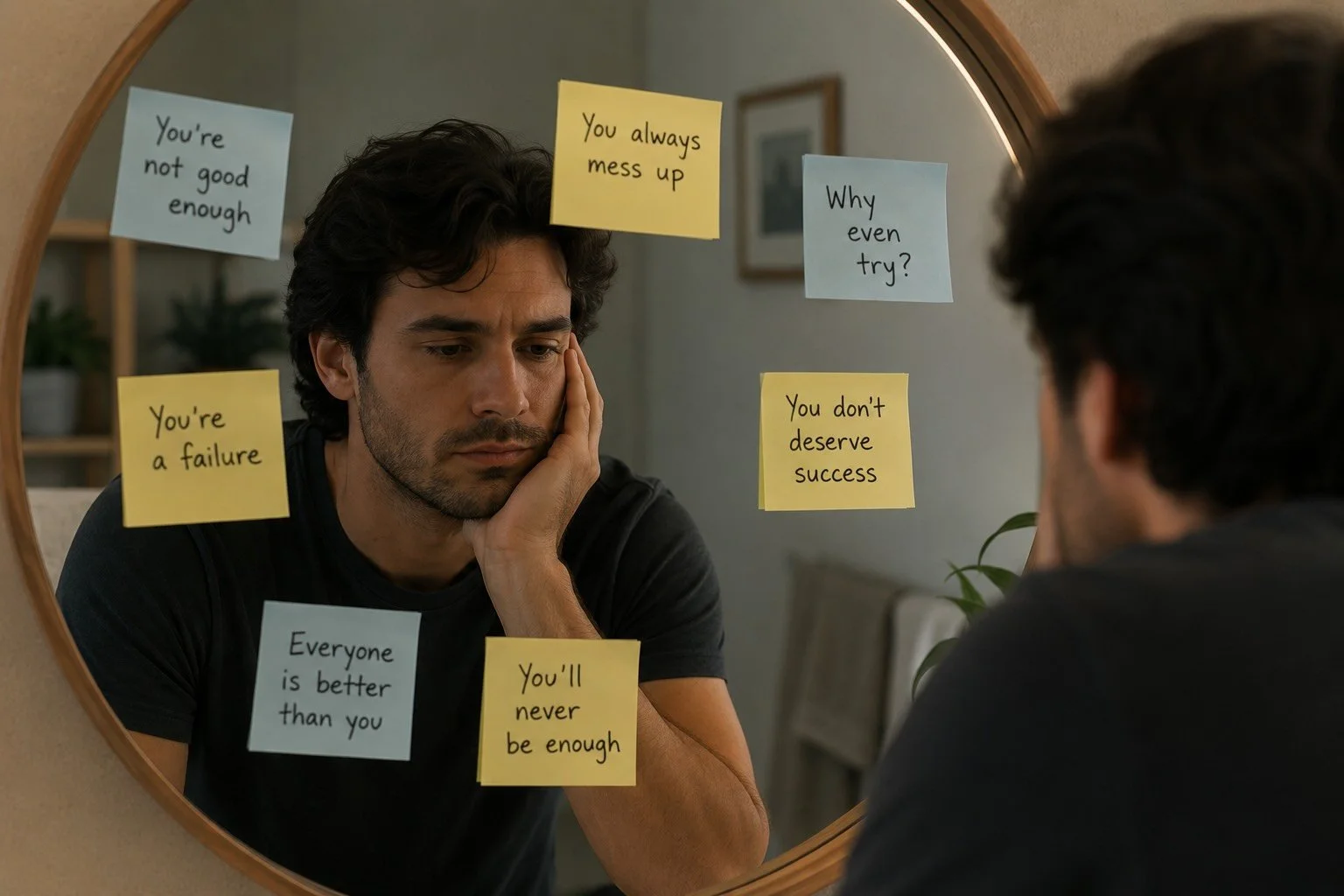
Negative self-talk is something almost everyone experiences. It's that internal voice that tells you you're not good enough, that you've made a mistake, that you're falling behind, or that you'll never succeed. Sometimes it's loud and obvious. Other times it's subtle, appearing as self-doubt, perfectionism, comparison, or the constant feeling that you should be doing more.
While occasional self-criticism is a normal part of being human, persistent negative self-talk can quietly shape how you see yourself, influence the decisions you make, and hold you back from living the life you want.
The encouraging news is that your inner critic isn't your identity. It's a learned mental habit. Like any habit, it can be understood, challenged, and gradually changed.
In this guide, we'll explore where negative self-talk comes from, why it persists, and most importantly, practical, evidence-based strategies to help you develop a healthier relationship with your thoughts.
What Is Negative Self-Talk?
Negative self-talk refers to the internal dialogue we have with ourselves that is overly critical, pessimistic, or discouraging. It's the running commentary in our minds that judges our performance, questions our abilities, and predicts failure before we've even begun.
Everyone has an internal dialogue. The difference isn't whether we talk to ourselves, but how we do it.
Healthy self-reflection might sound like:
"That presentation didn't go as well as I'd hoped. What could I do differently next time?"
Negative self-talk sounds more like:
"I'm terrible at presentations. Everyone must think I'm incompetent."
The first encourages learning. The second attacks your identity.
Your Inner Critic vs. Your Inner Coach
One of the easiest ways to understand negative self-talk is to compare your inner critic with what we might call your inner coach.
Inner Critic vs. Inner Coach
You're a failure → That didn't go as planned. What can you learn?
Personal attacks → Constructive feedback
Shame → Curiosity
Perfection → Progress
Fear → Growth
Harsh judgment → Honest encouragement
Notice that the inner coach doesn't ignore mistakes or pretend everything is perfect. Instead, it responds with honesty, perspective, and encouragement.
The goal isn't to eliminate self-reflection. It's to replace destructive criticism with constructive guidance.
Negative Self-Talk Isn't Always Obvious
Many people assume negative self-talk only sounds like harsh criticism. In reality, it often hides behind more subtle thought patterns, such as:
Constant self-doubt
Perfectionism
Comparing yourself to others
Feeling like you're never doing enough
Assuming the worst will happen
Blaming yourself for everything
Discounting your successes
Focusing only on your mistakes
Over time, these thoughts become so familiar that we stop noticing them altogether. They begin to feel like facts rather than opinions.
Why Do We Develop Negative Self-Talk?
If negative self-talk is so harmful, why does our brain create it in the first place?
The answer is surprisingly simple.
Your brain isn't trying to make you miserable.
It's trying to protect you.
Your Brain Is Built for Survival

For thousands of years, our ancestors survived by paying attention to danger. Missing a potential threat could have life-threatening consequences, while overlooking something positive rarely carried the same risk.
Psychologists often refer to this as the negativity bias. Our brains naturally notice problems more quickly than successes because that's how humans evolved to stay alive.
Although most of us no longer face predators or life-threatening environments, our brains still operate using many of these ancient survival mechanisms.
Today, the "threat" might not be physical danger. Instead, it could be:
Fear of rejection
Fear of failure
Fear of embarrassment
Fear of disappointing others
Fear of not belonging
Your inner critic often believes it's helping by trying to prevent these outcomes.
It says:
"Don't take the risk."
"Don't embarrass yourself."
"Don't fail."
Unfortunately, while this strategy may reduce short-term discomfort, it often increases anxiety and self-doubt over time.
Life Experiences Shape Your Inner Critic
Although our brains are naturally wired to notice potential threats, the specific voice of our inner critic develops through experience.
For many people, it begins early in life.
Common influences include:
Childhood criticism
Growing up with frequent criticism or unrealistic expectations can teach us that mistakes aren't safe.
Family expectations
Some families unintentionally communicate that love, praise, or acceptance depends on achievement.
Bullying or rejection
Repeated experiences of rejection can create beliefs such as:
"I'm not good enough."
"I don't fit in."
"People won't accept me."
High-achieving environments
Competitive schools and demanding workplaces often reinforce the idea that your worth depends on performance.
Social media
We compare our everyday lives to carefully edited highlights from other people's lives, making it easy to believe everyone else is happier, more successful, or further ahead.
Past failures
Disappointments can become powerful teachers—but not always in helpful ways.
Instead of concluding:
"That strategy didn't work."
our minds often conclude:
"I don't have what it takes."
The important thing to remember is this:
Your inner critic usually began as a protective strategy. It simply became overactive.
What Keeps Negative Self-Talk Going?
Many people assume negative self-talk continues because it's true.
In reality, it continues because it's reinforced.
Imagine this cycle.
Negative thought.
↓
Emotional discomfort.
↓
Avoidance, rumination, perfectionism, or seeking reassurance.
↓
Temporary relief.
↓
The brain concludes the thought was important.
↓
The belief grows stronger.
↓
Repeat.
Every time we avoid discomfort, our brain quietly learns:
"Good thing we listened."
Over time, the pattern becomes automatic.
Several habits strengthen this cycle.
Perfectionism
Perfectionism teaches us that anything less than perfect equals failure.
No matter how much we achieve, it never feels enough.
Comparison
Comparing ourselves to others almost always leaves us feeling inadequate because we compare our behind-the-scenes reality with someone else's highlight reel.
Conditional Self-Worth
Many people unknowingly live by rules such as:
"I'll be happy when..."
"I'll be worthy when..."
"I'll finally feel confident once..."
The goalposts keep moving.
Rumination
Instead of learning from mistakes, we replay them repeatedly.
The brain mistakes repetition for importance.
Shame
Healthy guilt says:
"I made a mistake."
Shame says:
"I am the mistake."
That's a profound difference.
Avoidance
Avoiding difficult conversations, new opportunities, or challenging situations provides temporary relief.
Unfortunately, it also confirms the belief that we weren't capable in the first place.
The Thinking Traps Behind Negative Self-Talk
Our thoughts aren't always accurate.
In fact, our brains regularly use mental shortcuts that distort reality.
Psychologists call these cognitive distortions or thinking traps.
Learning to recognise them is one of the most powerful ways to reduce negative self-talk.
All-or-Nothing Thinking
"If I'm not successful, I'm a failure."
Reality usually exists somewhere in between.
Catastrophising
Assuming the worst possible outcome.
"I made one mistake. I'm going to lose my job."
Mind Reading
Believing you know what other people think.
"They think I'm incompetent."
Without evidence, this is simply a story your mind is telling.
Fortune Telling
Predicting the future before it happens.
"I'll never succeed."
None of us can accurately predict the future.
Overgeneralisation
One event becomes a lifelong rule.
"I failed once, so I'll always fail."
Emotional Reasoning
"I feel anxious, therefore something must be wrong."
Feelings provide valuable information, but they aren't always objective evidence.
Labelling
Turning a behaviour into an identity.
Instead of saying:
"I made a mistake."
You say:
"I'm an idiot."
Discounting the Positive
Successes are dismissed as luck.
Achievements are minimised.
Mistakes become the only evidence that counts.
Recognising these thinking traps doesn't instantly eliminate them, but it helps create distance between you and your thoughts.
Once you can recognise the pattern, you're much less likely to believe it automatically.
How to Stop Negative Self-Talk

By now, you've probably realised something important.
Negative self-talk isn't simply about having negative thoughts. It's about the relationship you have with those thoughts.
The goal isn't to eliminate self-doubt or force yourself to think positively all the time. That's neither realistic nor necessary. Everyone experiences moments of uncertainty, frustration, and self-criticism.
Instead, the goal is to recognise when your inner critic is taking over and respond in a healthier, more balanced way.
Like any habit, changing negative self-talk takes practice. These strategies can help you gradually replace your inner critic with a more supportive inner coach.
1. Notice Your Inner Critic
The first step is surprisingly simple.
You can't change a thought that you don't notice.
For many people, negative self-talk has been running in the background for so long that it feels like reality rather than an opinion.
Start paying attention to the stories your mind tells you throughout the day.
Notice moments when you think things like:
"I'm not good enough."
"I always mess things up."
"Everyone else has it figured out."
"I should be doing more."
Simply noticing these thoughts creates a small but powerful gap between you and your inner critic.
Instead of becoming the thought, you begin observing it.
Try this: Spend one day simply noticing your negative self-talk without trying to change it. You may be surprised by how often it appears.
2. Recognise the Thinking Trap
Once you've noticed the thought, ask yourself:
"Is my mind using a thinking trap?"
Many negative thoughts are based on cognitive distortions rather than objective facts.
For example:
"I made one mistake." → Overgeneralisation
"They probably think I'm incompetent." → Mind Reading
"If this goes wrong, everything will fall apart." → Catastrophising
Simply naming the distortion helps reduce its emotional power.
Instead of believing the thought automatically, you begin to see it for what it is: one possible interpretation rather than reality.
3. Remember That Thoughts Are Not Facts
One of the most powerful mindset shifts is recognising that thoughts are mental events, not objective truths.
Your brain generates thousands of thoughts every day.
Some are accurate.
Some are helpful.
Many are neither.
Just because you think something doesn't mean you have to believe it.
A simple technique from Acceptance and Commitment Therapy (ACT) is to add the phrase:
"I'm having the thought that..."
Instead of saying:
"I'm a failure."
Try saying:
"I'm having the thought that I'm a failure."
It may seem like a small change, but it creates psychological distance.
Rather than becoming fused with the thought, you begin observing it.
That distance gives you the freedom to choose how you respond.
4. Challenge the Evidence
Once you've stepped back from the thought, become curious.
Ask yourself:
What evidence supports this thought?
What evidence contradicts it?
Am I overlooking important information?
Is there another explanation?
For example:
Instead of:
"I always fail."
Ask yourself:
"Always?"
You'll probably discover examples that don't fit the story.
This isn't about pretending everything is wonderful.
It's about replacing exaggerated thinking with balanced thinking.
Your goal isn't positive thinking.
It's accurate thinking.
5. Speak to Yourself Like Someone You Care About
Imagine a close friend came to you after making a mistake.
Would you tell them:
"You're useless."
Probably not.
You'd likely say something like:
"That was tough, but everyone makes mistakes. What can you learn from it?"
Yet many of us speak to ourselves in ways we'd never speak to someone we love.
Self-compassion isn't about making excuses or lowering your standards.
It's about recognising that being human means being imperfect.
Research consistently shows that people who practice self-compassion tend to be more resilient, less anxious, and more motivated after setbacks than those who rely on harsh self-criticism.
The next time your inner critic appears, ask yourself:
"How would I respond if someone I cared about were experiencing this?"
Then offer yourself that same kindness.
6. Replace Perfection with Progress
Perfectionism is one of the biggest drivers of negative self-talk.
When perfection becomes the standard, anything less feels like failure.
The problem is that perfection is an impossible target.
No matter how much you achieve, your inner critic simply moves the goalposts.
Instead of asking:
"Was it perfect?"
Ask yourself:
"Did I make progress?"
Progress builds confidence.
Perfection builds pressure.
A growth mindset reminds us that mistakes are not evidence of failure.
They're evidence that we're learning.
7. Build Self-Trust Through Action
Confidence rarely comes from thinking differently alone.
It grows from keeping small promises to yourself.
Every time you follow through on something meaningful, you quietly teach your brain:
"I'm someone who does what I say I'll do."
These actions don't need to be dramatic.
They might include:
Taking a five-minute walk.
Completing one important task.
Having a difficult conversation.
Keeping a commitment to yourself.
Trying something you've been avoiding.
Over time, these small moments become evidence that challenges your inner critic.
Instead of relying on positive affirmations, you begin building genuine self-trust.
8. Reduce the Habits That Feed Your Inner Critic
Sometimes the most effective way to quiet negative self-talk isn't changing the thought itself.
It's changing the conditions that make it louder.
Ask yourself:
Am I constantly comparing myself on social media?
Am I exhausted?
Am I overwhelmed?
Am I expecting perfection?
Am I surrounding myself with people who constantly criticise me?
Your inner critic tends to become louder when you're stressed, sleep-deprived, emotionally drained, or under constant pressure.
Looking after your physical and emotional wellbeing won't eliminate negative thoughts, but it makes them much easier to manage.
9. Practice, Don't Pursue Perfection
Many people expect negative self-talk to disappear once they've learned a few new techniques.
That's rarely how lasting change works.
Your inner critic may have been developing for years, or even decades.
It won't disappear overnight.
There will still be days when old thoughts return.
That's normal.
Success isn't measured by never having negative thoughts again.
It's measured by noticing them sooner, believing them less, and responding to them more compassionately.
Every time you choose curiosity over criticism...
Every time you challenge an unhelpful thought...
Every time you treat yourself with kindness instead of shame...
You're strengthening a healthier relationship with yourself.
And like any habit, that relationship grows stronger through repetition, not perfection.
Practical Exercises to Quiet Your Inner Critic

Understanding negative self-talk is the first step. Changing it requires practice.
Like any habit, your inner critic developed through repetition. The good news is that you can build a healthier inner dialogue in exactly the same way: through small, consistent actions.
The following exercises are designed to help you become more aware of your thoughts, question unhelpful beliefs, and gradually replace harsh self-criticism with a more balanced and compassionate perspective.
1. Catch the Critic Journal
For one day, simply notice your negative self-talk.
Each time you catch your inner critic, write down three things:
What happened?
What did I tell myself?
How did it make me feel?
Example
What happened?
I forgot an appointment.
What did I tell myself?
"I'm so disorganised."
How did it make me feel?
Frustrated.
The goal isn't to judge your thoughts or fix them immediately. It's simply to become more aware of how often they appear.
Awareness is the foundation of change.
2. Challenge the Evidence
Choose one recurring negative thought and put it on trial.
Ask yourself:
What evidence supports this thought?
What evidence contradicts it?
Am I overlooking important facts?
What would a more balanced perspective sound like?
Example
Negative thought
"I always fail."
Balanced response
"I've experienced setbacks before, but I've also succeeded many times. One mistake doesn't define me."
Remember, you're not trying to convince yourself everything is perfect.
You're aiming for a more accurate and balanced perspective.
3. The Friend Test
Imagine someone you care about came to you with the exact same thought you're having.
Would you respond with harsh criticism?
Or would you offer encouragement, understanding, and perspective?
Now ask yourself:
"Why don't I deserve the same kindness?"
Often, we're far more compassionate toward others than we are toward ourselves.
Practice speaking to yourself the way you would speak to someone you genuinely care about.
4. Build an Evidence Journal
Negative self-talk has a habit of ignoring your successes while focusing entirely on your mistakes.
Start collecting evidence that challenges your inner critic.
At the end of each day, write down three things you did well.
They don't have to be major achievements.
For example:
I completed a task I'd been putting off.
I went for a walk even though I didn't feel like it.
I handled a difficult conversation calmly.
I asked for help when I needed it.
I kept a promise I made to myself.
Over time, these small wins become powerful evidence that your inner critic isn't telling the whole story.
5. Rewrite the Story
Many of us have recurring thoughts that play on repeat.
Choose one that shows up regularly.
For example:
"I'm a failure."
Now rewrite it in a way that is honest, balanced, and compassionate.
Instead of:
"I'm a failure."
Try:
"Things didn't go the way I hoped, but one setback doesn't define who I am. I can learn from this and keep moving forward."
Notice that you're not replacing the thought with unrealistic positivity.
You're replacing it with something that's both truthful and helpful.
6. The 10 Thought Challenge
Spend one day simply counting how many times your inner critic appears.
Don't try to change the thoughts.
Don't judge yourself for having them.
Just notice.
You might be surprised how often your mind automatically criticises, compares, or predicts the worst.
Once you begin noticing these patterns, they become much easier to interrupt.
7. Create Your Inner Coach
Imagine having a wiser, calmer version of yourself sitting beside you.
Someone who wants you to succeed but doesn't expect perfection.
The next time your inner critic speaks, pause and ask:
"What would my inner coach say instead?"
For example:
Instead of:
"You'll never figure this out."
Your inner coach might respond:
"This is difficult, but you've solved difficult problems before. Take the next step and see what happens."
Over time, your goal isn't to silence your inner critic completely.
It's to strengthen the voice of your inner coach until it becomes the one you naturally listen to most.
Remember: Progress, Not Perfection
If you've spent years listening to your inner critic, don't expect it to disappear overnight.
Changing the way you speak to yourself is a gradual process.
Some days will feel easier than others.
Some old thoughts will return.
That's completely normal.
Every time you notice a negative thought instead of automatically believing it...
Every time you challenge an unhelpful belief...
Every time you respond with curiosity instead of criticism...
You're strengthening a healthier relationship with yourself.
Small moments of awareness, repeated consistently over time, can transform the way you think, feel, and respond to life's challenges.
The goal isn't to become someone who never experiences self-doubt.
The goal is to become someone who no longer lets self-doubt make all of the decisions.
Final Thoughts
Negative self-talk can feel convincing.
When you've been listening to the same critical voice for years, it's easy to mistake it for the truth. But your thoughts are not your identity, and they aren't always an accurate reflection of reality.
Your inner critic likely developed for a reason. It may have been trying to protect you from failure, rejection, embarrassment, or disappointment. The problem is that what once felt protective can eventually become limiting, preventing you from taking risks, recognising your strengths, and enjoying the progress you've already made.
The good news is that your inner dialogue isn't fixed.
Every time you notice a self-critical thought instead of automatically believing it, you're creating space for change. Every time you replace harsh judgment with curiosity, challenge an unhelpful belief, or speak to yourself with greater compassion, you're strengthening a healthier relationship with yourself.
Don't expect your inner critic to disappear overnight. Lasting change rarely happens through one breakthrough moment. It happens through small, consistent choices that gradually reshape the way you think and respond.
Remember, the goal isn't to become someone who never experiences negative thoughts.
The goal is to become someone who no longer lets those thoughts define their confidence, decisions, or sense of self-worth.
With patience, awareness, and practice, your inner coach can become louder than your inner critic.
And when that happens, you'll begin to approach challenges with greater confidence, setbacks with greater resilience, and yourself with the kindness you deserve.
After all, the voice you hear most often is your own.
Make it one that helps you grow.
👉 Let’s talk if what you’ve read resonates and you’re curious whether coaching could help, let’s explore it together.
